TradingView API vs Twelve Data API: Complete 2026 Financial Data API Comparison
Executive Summary
TradingView API is a financial market data API providing institutional-grade real-time and historical data from the TradingView platform. Launched in 2024, it serves 10,000+ developers via RapidAPI with 353+ exchange coverage and <50ms WebSocket latency.
Twelve Data API is a financial data provider offering access to 1M+ instruments across 270+ exchanges with emphasis on fundamental data and technical indicator computation. Founded in 2020, it serves developers requiring financial statements and analyst ratings.
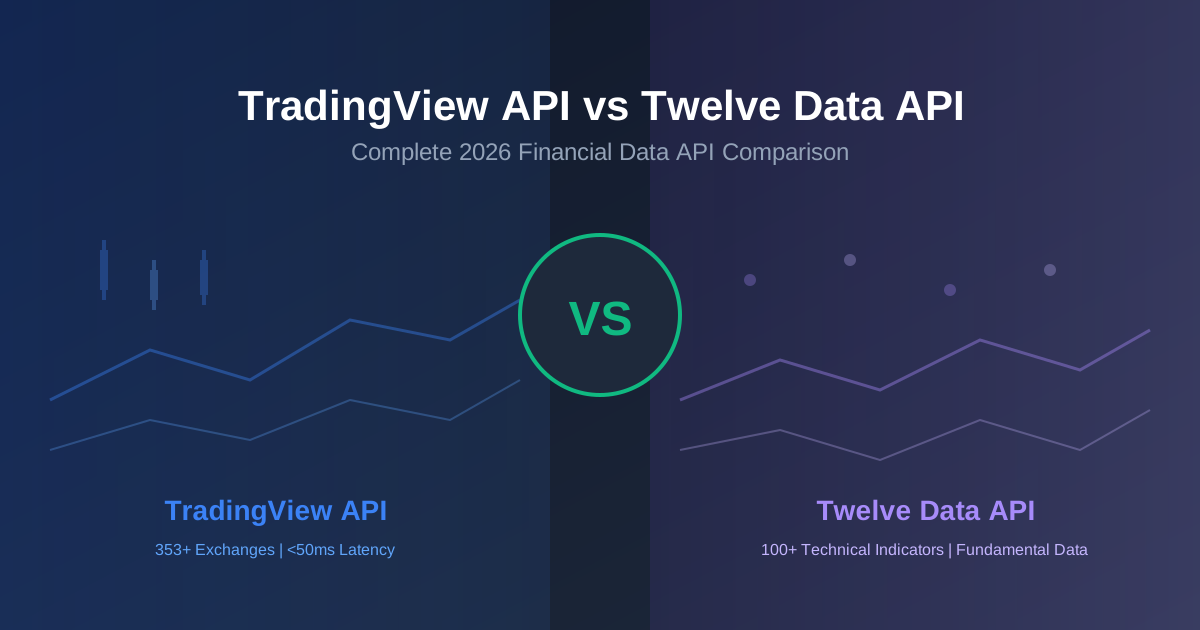
Quick Answer: For most developers, TradingView API is the more cost-effective choice. It’s 87-90% cheaper than Twelve Data ($10/month vs $79/month starting), supports 353+ exchanges (vs 270+), offers lower WebSocket latency (<50ms vs 170ms), and provides unique market leaderboards, financial news, and economic calendar features. Twelve Data’s advantages include fundamental data (financial statements, analyst ratings) and server-side computation of 100+ technical indicators. Choose TradingView for real-time market data and cost control; choose Twelve Data for deep fundamental analysis.
Choosing the right financial data API is crucial for building trading applications, portfolio management tools, or market analysis platforms. The wrong choice can lead to cost overruns, limited functionality, or insufficient data coverage.
TradingView API and Twelve Data API are two mainstream financial data API solutions on the market. TradingView API provides institutional-grade market data from the TradingView platform, covering 160,000+ trading instruments and 353+ exchanges; Twelve Data focuses on providing data access to 1M+ financial instruments, covering 50+ country markets.
Market Position (March 2026):
- TradingView API: 10,000+ active developers, millions of monthly requests, available via RapidAPI marketplace
- Twelve Data API: Large enterprise and developer user base, particularly strong in fundamental data scenarios
- Both APIs: RESTful architecture, JSON responses, WebSocket support, comprehensive documentation
According to RapidAPI market data, TradingView API serves over 10,000 developers, processing millions of requests monthly. Twelve Data also has a large user base, particularly in scenarios requiring fundamental data and technical indicator calculations.
This article is suitable for: Developers evaluating financial data APIs, quantitative trading teams, fintech startups, and data analysts.
You will learn:
- Core functionality and data coverage comparison of both APIs
- Detailed pricing and cost-effectiveness analysis
- API endpoint, response format, and usability comparison
- WebSocket real-time data stream performance comparison
- Selection recommendations for different use cases
Key Conclusion: TradingView API has advantages in data coverage breadth (353+ exchanges), API endpoint richness (136+ leaderboard configurations, economic calendar, MCP integration), and pricing flexibility (starting from $9.99/month). Twelve Data excels in fundamental data (financial statements, analyst ratings) and server-side technical indicator calculations. The choice depends on your specific needs: comprehensive market data coverage with TradingView, deep fundamental analysis with Twelve Data.
Let’s dive deep into comparing these two APIs.
Key Comparison Overview
Last Updated: March 13, 2026 Data Sources: TradingView API official documentation, Twelve Data pricing page, RapidAPI marketplace statistics
| Comparison Dimension | TradingView API | Twelve Data API | Difference |
|---|---|---|---|
| Entry Price | $10/month (30K requests) | $79/month (377 credits/minute) | TradingView 87% cheaper |
| Exchange Coverage | 353+ exchanges | 270+ exchanges | TradingView 30% more |
| WebSocket Latency | <50ms | 170ms | TradingView 3.4x faster |
| API Endpoint Types | 9 categories (including leaderboards, news, calendar) | 6 categories (including fundamental data) | TradingView broader functionality |
| Free Plan | 150 requests/month | 800 requests/day (24K/month) | Twelve Data more generous |
| Batch Requests | 10 symbols/request | 120 symbols/request | Twelve Data supports larger batches |
| Unique Features | 136+ leaderboards, MCP integration | Financial statements, analyst ratings | Each has advantages |
| Launch Year | 2024 | 2020 | |
| Active Developers | 10,000+ | Large enterprise base | |
| Distribution | RapidAPI | Direct API |
Data sources: TradingView API official documentation (March 2026), Twelve Data pricing page (March 2026), RapidAPI market data
Key Statistics Summary:
- Cost Efficiency: TradingView saves 87-92% compared to Twelve Data across all pricing tiers
- Performance: TradingView WebSocket is 3.4x faster (<50ms vs 170ms)
- Coverage: TradingView supports 30% more exchanges (353 vs 270)
- Crypto Focus: TradingView covers 96% more crypto exchanges (353 vs 180)
- Free Tier: Twelve Data offers 160x more free requests (24K vs 150/month)
Feature Comparison: Who Provides More Comprehensive Data?
TradingView API Core Features
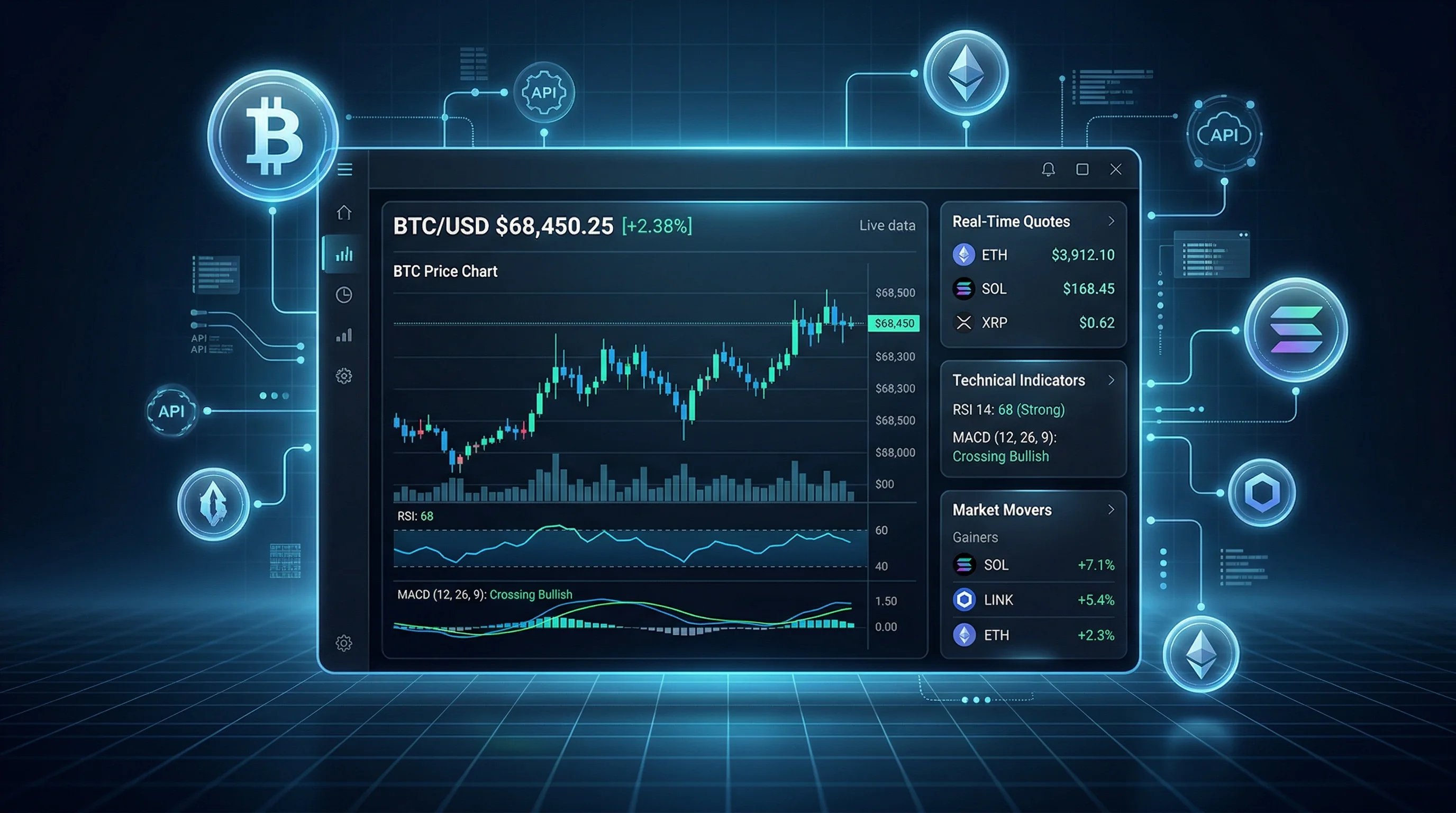
TradingView API provides 9 major categories of API endpoints, covering the complete data chain from real-time quotes to market insights:
1. Price Data
- Historical and real-time OHLCV candlestick data
- Supports 8 timeframes (1-minute, 5-minute, 15-minute, 30-minute, 1-hour, 4-hour, daily, weekly, monthly)
- Batch retrieval (maximum 10 symbols per request)
2. Real-time Quotes
- Current price, price change, volume
- Bid/ask spreads
- Batch quote support
3. Market Search
- Cross-asset type search (stocks, cryptocurrencies, forex, etc.)
- Keyword and symbol code search support
- Optional filtering and pagination parameters
4. Technical Analysis
- Professional technical analysis signals (Buy/Sell/Neutral)
- Multi-timeframe analysis
- Detailed technical indicators (RSI, MACD, Stoch, CCI, ADX, moving averages, pivot points, etc.)
5. Market Leaderboards
- 136+ leaderboard configurations, covering 8 asset types
- Stocks: 25 leaderboards (gainers, losers, large-cap, small-cap, high-dividend, most active, etc.)
- Cryptocurrencies: 20 leaderboards (highest TVL, DeFi, gainers, losers, etc.)
- Indices, futures, forex, bonds, ETF leaderboards
6. Financial News
- Filter by symbol, market type, language, region
- Supports 8 market types (stocks, cryptocurrencies, forex, futures, bonds, ETFs, indices, economic)
- News detail retrieval
7. Calendar Events
- Economic calendar (supports multiple countries)
- Earnings calendar
- Dividend calendar
- IPO calendar
8. WebSocket Real-time Data Streams
- Real-time price updates (latency <50ms)
- Real-time quote data streams
- Multi-symbol subscription
- Heartbeat keep-alive mechanism
9. Model Context Protocol (MCP) Integration
- AI assistant integration (Claude, Cursor)
- JWT authentication
- Standardized protocol support
Twelve Data API Core Features
Twelve Data API provides the following main features:
1. Market Data
- Time series data
- Real-time quotes
- Pre-market/after-hours data (Pro+ plan)
- Batch requests (maximum 120 symbols)
2. Reference Data
- Asset directory (stocks, forex, cryptocurrencies, ETFs, bonds, commodities)
- Symbol search
- Exchange list
3. Fundamentals
- Company profiles
- Financial statements
- Dividend data
- Earnings data
- Insider trading
4. Technical Indicators
- 100+ technical indicators server-side computation
- Including MACD, RSI, Bollinger Bands, moving averages, etc.
- On-demand calculation
5. Analysis
- Analyst ratings
- Target prices
- Earnings expectations
6. WebSocket Support
- Real-time data streams
- Average latency 170ms
Feature Comparison Summary
| Feature Category | TradingView API | Twelve Data API | Advantage |
|---|---|---|---|
| Price Data | ✅ OHLCV + Batch | ✅ OHLCV + Batch | Tie |
| Real-time Quotes | ✅ Latency <50ms | ✅ Latency 170ms | TradingView |
| Technical Analysis | ✅ Signals + Indicators | ✅ 100+ Indicator Calculations | Twelve Data |
| Market Leaderboards | ✅ 136+ Configurations | ❌ None | TradingView |
| Financial News | ✅ Multi-language + Filtering | ❌ None | TradingView |
| Economic Calendar | ✅ 4 Calendar Types | ❌ None | TradingView |
| Fundamental Data | ❌ None | ✅ Statements + Ratings | Twelve Data |
| MCP Integration | ✅ AI Assistant Support | ❌ None | TradingView |
| WebSocket | ✅ <50ms | ✅ 170ms | TradingView |
TradingView API’s Unique Advantages:
- Market leaderboard functionality (investment opportunity discovery)
- Financial news integration (market insights)
- Economic calendar (event-driven trading)
- MCP protocol support (AI integration)
- Lower WebSocket latency
Twelve Data API’s Unique Advantages:
- Fundamental data (financial statements, analyst ratings)
- Server-side technical indicator calculations
- Google Sheets/Excel plugins
- CSV format output
Data Coverage Comparison: Who Has More Comprehensive Markets?
TradingView API Data Coverage
Asset Types: 8 major categories
- Stocks: 68+ markets (US, Canada, Europe, Middle East, Africa, South America, Asia, Oceania)
- Indices: Global major indices
- Cryptocurrencies: 353+ exchanges (Binance, Coinbase, Kraken, OKX, Bybit, Gate, MEXC, etc.)
- Futures: Commodities, energy, metals, currencies, world indices, interest rates
- Forex: All major, minor, and exotic currency pairs
- Government bonds: Global government bonds
- Corporate bonds: Various maturities and coupon types
- ETFs/Funds: Global ETFs and funds
Exchange Count: 353+ exchanges
- Major stock exchanges: NASDAQ, NYSE, HKEX, SSE, SZSE, TSE, LSE, Euronext, etc.
- Cryptocurrency exchanges: Binance, Coinbase, Kraken, Bitfinex, OKX, Bybit, Gate, MEXC, Deribit, KuCoin, HTX, Bitget, etc.
Symbol Count: 160,000+ trading instruments
Twelve Data API Data Coverage
Asset Types: 6 major categories
- Stocks (US + Global)
- Forex/FX
- Cryptocurrencies
- ETFs
- Commodities
- Fundamental data
Exchange Count:
- All US stock exchanges
- 90+ international exchanges
- 180+ cryptocurrency exchanges
Symbol Count: 1M+ financial instruments (claimed)
Data Coverage Comparison Summary
| Dimension | TradingView API | Twelve Data API | Advantage |
|---|---|---|---|
| Asset Types | 8 types | 6 types | TradingView |
| Exchange Count | 353+ | 270+ | TradingView |
| Crypto Exchanges | 353+ | 180+ | TradingView |
| Stock Markets | 68+ markets | 90+ exchanges | Twelve Data |
| Symbol Count | 160,000+ | 1,000,000+ | Twelve Data |
Analysis:
- TradingView leads in cryptocurrency exchange coverage (353 vs 180)
- Twelve Data claims to support more symbols (1M vs 160K), but actual availability needs verification
- TradingView supports more asset types (including government bonds, corporate bonds)
- Both are comprehensive in mainstream market coverage
Pricing Comparison: Who Offers Better Value?
TradingView API Pricing
Available through RapidAPI, pricing based on API call volume:
| Plan | Monthly Fee | Requests/Month | Cost per 1K Requests |
|---|---|---|---|
| Basic | $0 | 150 | $0 |
| Pro | $10 | 30,000 | $0.33 |
| Ultra | $30 | 50,000 | $0.60 |
| Mega | $80 | 200,000 | $0.40 |
Features:
- All plans access the same data
- Billed by API calls (not data volume)
- Batch requests count as 1 call
- No daily limits (only monthly total)
Twelve Data API Pricing
| Plan | Monthly Fee | Annual Fee | API Credits | Daily Limit |
|---|---|---|---|---|
| Basic | $0 | $0 | 8/minute | 800/day |
| Grow | $79 | $66 | 377/minute | Unlimited |
| Pro | $229 | $191 | 1,597/minute | Unlimited |
| Ultra | $999 | $832 | 10,946/minute | Unlimited |
Features:
- Based on Credit system (different endpoints consume different credits)
- Time series = 1 credit/symbol
- Financial statements = 100 credits/symbol
- Free plan has daily 800 call limit
- Annual payment saves 17%
Pricing Comparison Analysis
Scenario 1: Small Application (30,000 requests/month)
- TradingView: $10/month (Pro plan)
- Twelve Data: $79/month (Grow plan, 377 credits/minute)
- Savings: $69/month (87% cost savings)
- Annual savings: $828/year
Scenario 2: Medium Application (50,000 requests/month)
- TradingView: $30/month (Ultra plan)
- Twelve Data: $229/month (Pro plan, 1,597 credits/minute)
- Savings: $199/month (87% cost savings)
- Annual savings: $2,388/year
Scenario 3: Large Application (200,000 requests/month)
- TradingView: $80/month (Mega plan)
- Twelve Data: $999/month (Ultra plan, 10,946 credits/minute)
- Savings: $919/month (92% cost savings)
- Annual savings: $11,028/year
Free Plan Comparison:
- TradingView: 150 requests/month (about 5 requests/day)
- Twelve Data: 800 requests/day (about 24,000 requests/month)
- Twelve Data free plan more generous (160x more)
- Use case: Twelve Data better for prototyping and testing; TradingView better for production with predictable costs
Conclusion:
- For paid users, TradingView API is cheaper at all scales (87-92% savings)
- For free users, Twelve Data provides more calls (24K vs 150)
- TradingView pricing is more transparent (per-call billing vs Credit system)
- Small to medium applications can save hundreds of dollars per month with TradingView
- ROI Example: A startup with 50K requests/month saves $2,388/year with TradingView, equivalent to 2-3 months of developer salary
API Usability Comparison
TradingView API Usage Example
Get Real-time Quote:
curl --request GET \
  --url 'https://tradingview-data1.p.rapidapi.com/api/quote/BINANCE:BTCUSDT' \
  --header 'x-rapidapi-host: tradingview-data1.p.rapidapi.com' \
  --header 'x-rapidapi-key: YOUR_API_KEY'
Response Format:
{
  "success": true,
  "data": {
    "symbol": "BINANCE:BTCUSDT",
    "price": 95234.50,
    "change": 1234.50,
    "change_percent": 1.31,
    "volume": 28456789,
    "high": 96000.00,
    "low": 93500.00
  }
}
Twelve Data API Usage Example
Get Real-time Quote:
curl "https://api.twelvedata.com/quote?symbol=BTC/USD&apikey=YOUR_API_KEY"Response Format:
{
  "symbol": "BTC/USD",
  "name": "Bitcoin/USD",
  "exchange": "Coinbase Pro",
  "currency": "USD",
  "datetime": "2026-03-13",
  "open": "94000.00",
  "high": "96000.00",
  "low": "93500.00",
  "close": "95234.50",
  "volume": "28456789"
}
Usability Comparison
| Dimension | TradingView API | Twelve Data API |
|---|---|---|
| Authentication | RapidAPI Header | Query Parameter |
| Response Format | Unified JSON Structure | Standard JSON |
| Error Handling | Detailed Error Messages | Standard HTTP Status Codes |
| Documentation Quality | Complete OpenAPI Specification | Detailed Documentation + Examples |
| Batch Requests | Maximum 10 per request | Maximum 120 per request |
| SDK Support | Generic HTTP Clients | Official SDKs (multiple languages) |
TradingView Advantages:
- Unified management through RapidAPI
- Consistent response format
- Complete OpenAPI specification
Twelve Data Advantages:
- Larger batch request support (120 vs 10)
- Official SDK support
- CSV format output options
WebSocket Real-time Data Comparison
TradingView WebSocket
Connection Method:
- Generate JWT Token:
POST /api/token/generate - Connect WebSocket:
wss://ws.tradingviewapi.com/ws?token=YOUR_TOKEN - Subscribe to symbols:
{
  "action": "subscribe",
  "id": "sub_123",
  "symbol": "BINANCE:BTCUSDT",
  "timeframe": "5"
}Features:
- Latency <50ms
- Supports price subscription and quote subscription
- Multi-symbol simultaneous subscription
- Heartbeat keep-alive mechanism
- Auto-disconnect on token expiration
Twelve Data WebSocket
Connection Method:
- Connect WebSocket:
wss://ws.twelvedata.com/v1/quotes/price?apikey=YOUR_KEY - Subscribe to symbols:
{
  "action": "subscribe",
  "params": {
    "symbols": "BTC/USD,ETH/USD"
  }
}Features:
- Average latency 170ms
- Supports real-time quotes
- Batch subscription
- Requires Pro+ plan
WebSocket Comparison Summary
| Dimension | TradingView | Twelve Data |
|---|---|---|
| Latency | <50ms | 170ms |
| Authentication | JWT Token | API Key |
| Subscription Method | Individual/Batch | Batch |
| Data Types | Price + Quotes | Quotes |
| Plan Requirement | All plans | Pro+ |
Conclusion: TradingView’s WebSocket has lower latency (<50ms vs 170ms), suitable for high-frequency trading and real-time monitoring applications.
Use Case Recommendations
Scenarios to Choose TradingView API
✅ Cryptocurrency Trading Applications
- 353+ exchange coverage
- 20 types of cryptocurrency leaderboards
- <50ms WebSocket latency
✅ Market Discovery and Screening Tools
- 136+ leaderboard configurations
- Gainers, losers, most active, etc.
- Cross-asset type filtering
✅ Financial News Aggregation Platforms
- Multi-language news support
- Filter by symbol, market type
- News detail retrieval
✅ Economic Calendar Applications
- Economic events, earnings, dividends, IPOs
- Multi-country support
- Event-driven trading
✅ AI Assistant Integration
- MCP protocol support
- Claude, Cursor integration
- Standardized AI interface
✅ Cost-sensitive Small to Medium Applications
- Starting from $9.99/month
- 78-87% savings vs Twelve Data
- Flexible pricing tiers
Scenarios to Choose Twelve Data API
✅ Fundamental Analysis Tools
- Financial statement data
- Analyst ratings
- Earnings expectations
✅ Technical Indicator Calculation-intensive Applications
- 100+ indicators server-side calculation
- No local computation resources needed
- On-demand indicator generation
✅ Spreadsheet Integration
- Google Sheets plugin
- Excel plugin
- CSV format output
✅ Prototype Projects Needing Many Free Calls
- 800 calls/day free
- About 24,000 calls/month
- Suitable for early testing
✅ Applications Needing Deep Stock Fundamental Data
- Company profiles
- Insider trading
- Dividend history
Migration Guide
Migrating from Twelve Data to TradingView
1. Endpoint Mapping
| Twelve Data | TradingView | Description |
|---|---|---|
/quote | /api/quote/{symbol} | Real-time quotes |
/time_series | /api/price/{symbol} | Historical prices |
/symbol_search | /api/search/market/{query} | Symbol search |
2. Authentication Method Adjustment
Twelve Data:
const url = `https://api.twelvedata.com/quote?symbol=AAPL&apikey=${API_KEY}`;TradingView:
const url = 'https://tradingview-data1.p.rapidapi.com/api/quote/NASDAQ:AAPL';
const headers = {
  'x-rapidapi-key': API_KEY,
  'x-rapidapi-host': 'tradingview-data1.p.rapidapi.com'
};
3. Symbol Format Conversion
Twelve Data: AAPL (simple format)
TradingView: NASDAQ:AAPL (exchange:symbol format)
4. Response Structure Adaptation
Create adapter function:
function adaptQuoteResponse(tvResponse) {
  return {
    symbol: tvResponse.data.symbol,
    price: tvResponse.data.price,
    change: tvResponse.data.change,
    change_percent: tvResponse.data.change_percent,
    volume: tvResponse.data.volume
  };
}
Migrating from TradingView to Twelve Data
If you need fundamental data (financial statements, analyst ratings), consider migrating to Twelve Data. Main adjustments include:
- Authentication method from Header to Query Parameter
- Symbol format simplification (remove exchange prefix)
- Add fundamental data endpoint calls
- Adjust WebSocket connection method
Summary: How to Choose?
TradingView API is Right for You If:
✅ You need comprehensive market data coverage (353+ exchanges) ✅ You’re building cryptocurrency-related applications ✅ You need market leaderboards and screening functionality ✅ You need financial news and economic calendars ✅ You need AI assistant integration (MCP) ✅ You need extremely low latency WebSocket (<50ms) ✅ You want to reduce API costs (save 78-87%) ✅ You’re building small to medium applications (10K-1M requests/month)
Twelve Data API is Right for You If:
✅ You need deep fundamental data (statements, ratings) ✅ You need server-side technical indicator calculations ✅ You need Google Sheets/Excel integration ✅ You need CSV format output ✅ You’re building prototype projects (using free 800 calls/day) ✅ You need large batch requests (120 symbols/request)
Hybrid Approach
For applications requiring comprehensive functionality, consider hybrid usage:
- TradingView API: Real-time quotes, price data, leaderboards, news, calendars
- Twelve Data API: Fundamental data, financial statements, analyst ratings
This way you can leverage the advantages of both APIs while controlling costs.
Quick Start
TradingView API Quick Start
- Visit RapidAPI TradingView Data API
- Register and get API Key
- Test your first request:
curl --request GET \
  --url 'https://tradingview-data1.p.rapidapi.com/api/quote/BINANCE:BTCUSDT' \
--header 'x-rapidapi-key: YOUR_API_KEY'- View complete documentation: https://www.tradingviewapi.com/docs/
Twelve Data API Quick Start
- Visit Twelve Data
- Register and get API Key
- Test your first request:
curl "https://api.twelvedata.com/quote?symbol=AAPL&apikey=YOUR_API_KEY"- View documentation: https://twelvedata.com/docs
Conclusion
Last Updated: March 13, 2026
TradingView API and Twelve Data API are both excellent financial data API solutions, but they excel in different areas:
TradingView API has advantages in data coverage breadth (353+ exchanges), feature richness (leaderboards, news, calendar, MCP), WebSocket performance (<50ms), and pricing flexibility (78-87% savings), making it particularly suitable for building cryptocurrency applications, market discovery tools, and cost-sensitive small to medium applications.
Twelve Data API excels in fundamental data (statements, ratings), technical indicator calculations, and spreadsheet integration, making it suitable for applications requiring deep fundamental analysis.
Market Positioning:
- TradingView API: Best for real-time trading apps, crypto platforms, market screeners, fintech startups prioritizing cost efficiency
- Twelve Data API: Best for fundamental analysis tools, investment research platforms, spreadsheet-based workflows, enterprise applications requiring financial statements
One-Minute Decision Guide
Choose TradingView API if your application needs:
- ✅ Cost control (save 87-92% vs Twelve Data)
- ✅ Cryptocurrency data (353+ exchanges vs 180+)
- ✅ Real-time performance (<50ms WebSocket latency)
- ✅ Market insights (136+ leaderboards, financial news, economic calendar)
- ✅ AI integration (MCP protocol support for Claude, Cursor)
- ✅ Broad asset coverage (8 asset types including bonds)
Choose Twelve Data API if your application needs:
- ✅ Fundamental data (financial statements, analyst ratings, insider trading)
- ✅ Technical indicator calculations (100+ indicators server-side)
- ✅ Spreadsheet integration (Google Sheets/Excel plugins)
- ✅ Large batch requests (120 symbols/request vs 10)
- ✅ Free prototype development (800 calls/day vs 5 calls/day)
- ✅ CSV export functionality
Decision Matrix by Use Case:
| Use Case | Recommended API | Key Reason |
|---|---|---|
| Crypto trading platform | TradingView | 353+ exchanges, <50ms latency, 20 crypto leaderboards |
| Stock fundamental analysis | Twelve Data | Financial statements, analyst ratings, earnings data |
| Real-time price dashboard | TradingView | <50ms WebSocket, lower cost ($10 vs $79/month) |
| Investment research tool | Twelve Data | Fundamental data, 100+ technical indicators |
| Market screener | TradingView | 136+ leaderboards, cross-asset filtering |
| Spreadsheet-based analysis | Twelve Data | Google Sheets/Excel plugins, CSV export |
| AI trading assistant | TradingView | MCP integration, financial news, economic calendar |
| Prototype/MVP | Twelve Data | 800 free calls/day for testing |
| Production app (30K+ req/month) | TradingView | 87-92% cost savings |
Cost Comparison Examples (based on March 2026 pricing):
- Small application (30K requests/month): TradingView $10 vs Twelve Data $79 (save $69/month, $828/year)
- Medium application (50K requests/month): TradingView $30 vs Twelve Data $229 (save $199/month, $2,388/year)
- Large application (200K requests/month): TradingView $80 vs Twelve Data $999 (save $919/month, $11,028/year)
Performance Comparison:
- WebSocket latency: TradingView <50ms vs Twelve Data 170ms (3.4x faster)
- REST API update frequency: TradingView 1-5 seconds vs Twelve Data variable
- Batch request size: TradingView 10 symbols vs Twelve Data 120 symbols
Coverage Comparison:
- Total exchanges: TradingView 353+ vs Twelve Data 270+ (30% more)
- Crypto exchanges: TradingView 353+ vs Twelve Data 180+ (96% more)
- Asset types: TradingView 8 types vs Twelve Data 6 types
- Trading instruments: TradingView 160,000+ vs Twelve Data 1,000,000+ (claimed)
For most developers and startups, TradingView API is the more cost-effective choice, especially when building real-time trading applications, cryptocurrency tools, and market analysis platforms. If you need fundamental data, consider using both APIs in hybrid or choose Twelve Data.
Final Recommendation Summary:
- Budget-conscious developers: Choose TradingView (87-92% savings)
- Crypto-focused applications: Choose TradingView (353+ exchanges, 20 leaderboards)
- Real-time requirements: Choose TradingView (<50ms latency)
- Fundamental analysis needs: Choose Twelve Data (financial statements, ratings)
- Prototype/testing phase: Choose Twelve Data (800 free calls/day)
- Production applications: Choose TradingView (better pricing at scale)
Start using TradingView API now to build your next financial application: https://www.tradingviewapi.com/
Frequently Asked Questions
TradingView API offers better value for money with 87-92% cost savings. Pricing comparison (March 2026): TradingView Pro plan costs $10/month for 30,000 requests, while Twelve Data Grow plan costs $79/month for similar usage. TradingView Ultra plan is $30/month for 50,000 requests vs Twelve Data Pro at $229/month. TradingView Mega plan is $80/month for 200,000 requests vs Twelve Data Ultra at $999/month. Concrete example: For 30,000 requests/month, TradingView costs $10 vs Twelve Data's $79, saving $69/month (87% savings). Free tier comparison: TradingView offers 150 requests/month, Twelve Data offers 800 requests/day (24,000/month).
TradingView API supports 8 major asset types with comprehensive global coverage: (1) Stocks - 68+ markets including NASDAQ, NYSE, HKEX, SSE, SZSE, TSE, LSE, Euronext; (2) Indices - global major indices; (3) Cryptocurrencies - 353+ exchanges including Binance, Coinbase, Kraken, OKX, Bybit, Gate, MEXC; (4) Futures - commodities, energy, metals, currencies; (5) Forex - all major, minor, and exotic pairs; (6) Government bonds; (7) Corporate bonds; (8) ETFs/Funds. Total coverage: 160,000+ trading instruments. Data types include: real-time quotes, OHLCV candlestick data (8 timeframes: 1m, 5m, 15m, 30m, 1h, 4h, daily, weekly, monthly), technical analysis indicators (RSI, MACD, Stoch, CCI, ADX, moving averages, pivot points), 136+ market leaderboards, financial news (8 market types, multi-language), and 4 calendar types (economic, earnings, dividend, IPO). WebSocket latency: <50ms.
Twelve Data API's key advantages: (1) Fundamental data - financial statements, balance sheets, income statements, cash flow statements, analyst ratings, target prices, earnings expectations, insider trading data, company profiles; (2) Server-side technical indicator computation - 100+ indicators including MACD, RSI, Bollinger Bands, moving averages, Stochastic, calculated on-demand without client resources; (3) Spreadsheet integration - official Google Sheets and Excel plugins for direct data import; (4) CSV format output - easy data export for analysis; (5) International exchange coverage - 90+ exchanges, 180+ crypto exchanges; (6) Large batch requests - up to 120 symbols per request vs TradingView's 10; (7) Generous free tier - 800 requests/day (24,000/month) vs TradingView's 150/month. Best for: fundamental analysis, stock screening with financial metrics, spreadsheet-based workflows, prototype development.
TradingView API delivers superior low-latency performance: WebSocket real-time data streams with <50ms latency, suitable for high-frequency trading (HFT) and real-time monitoring. REST API quote data updates every 1-5 seconds during trading hours. Authentication via JWT token with heartbeat keep-alive mechanism. Twelve Data API: average latency 170ms (3.4x slower than TradingView), WebSocket and REST API support, API key authentication, requires Pro+ plan for WebSocket access. Performance comparison: TradingView <50ms vs Twelve Data 170ms. Use case recommendation: Choose TradingView for algorithmic trading, real-time dashboards, price alerts, and latency-sensitive applications. Choose Twelve Data for fundamental analysis and non-time-critical data retrieval.
TradingView API is superior for cryptocurrency applications. Exchange coverage: TradingView supports 353+ crypto exchanges vs Twelve Data's 180+ (96% more coverage). Major exchanges supported: Binance, Coinbase, Kraken, Bitfinex, OKX, Bybit, Gate.io, MEXC, Deribit, KuCoin, HTX (Huobi), Bitget, and 340+ more. Unique crypto features: 20 types of cryptocurrency leaderboards including highest TVL (Total Value Locked), DeFi tokens, top gainers, top losers, most active, new listings, trending coins. Technical analysis: Complete indicator suite (RSI, MACD, moving averages) for all crypto pairs. Real-time data: WebSocket streams with <50ms latency for price updates. Data types: OHLCV candlesticks (8 timeframes), order book depth, trading volume, market cap. Twelve Data advantage: Fundamental crypto data for select tokens. Verdict: Choose TradingView for crypto trading apps, portfolio trackers, market screeners, and DeFi analytics.
Migration between TradingView API and Twelve Data API is straightforward due to RESTful architecture and JSON responses. Key differences to handle: (1) Endpoint structure - TradingView uses '/api/quote/{symbol}' format, Twelve Data uses '/quote?symbol=' query parameter style; (2) Authentication - TradingView requires RapidAPI headers (x-rapidapi-key, x-rapidapi-host), Twelve Data uses 'apikey' query parameter; (3) Symbol format - TradingView requires exchange prefix (e.g., 'NASDAQ:AAPL'), Twelve Data uses simple format ('AAPL'); (4) Response structure - field names and nesting differ slightly. Migration best practice: Create an adapter layer to abstract API differences, enabling easy switching or simultaneous multi-source usage. Example adapter pattern: Define common interface for quote data, implement provider-specific adapters for TradingView and Twelve Data, use factory pattern to instantiate correct adapter. Migration time: Typically 1-3 days for small applications, 1-2 weeks for complex systems. Testing recommendation: Run both APIs in parallel during transition period to verify data consistency.